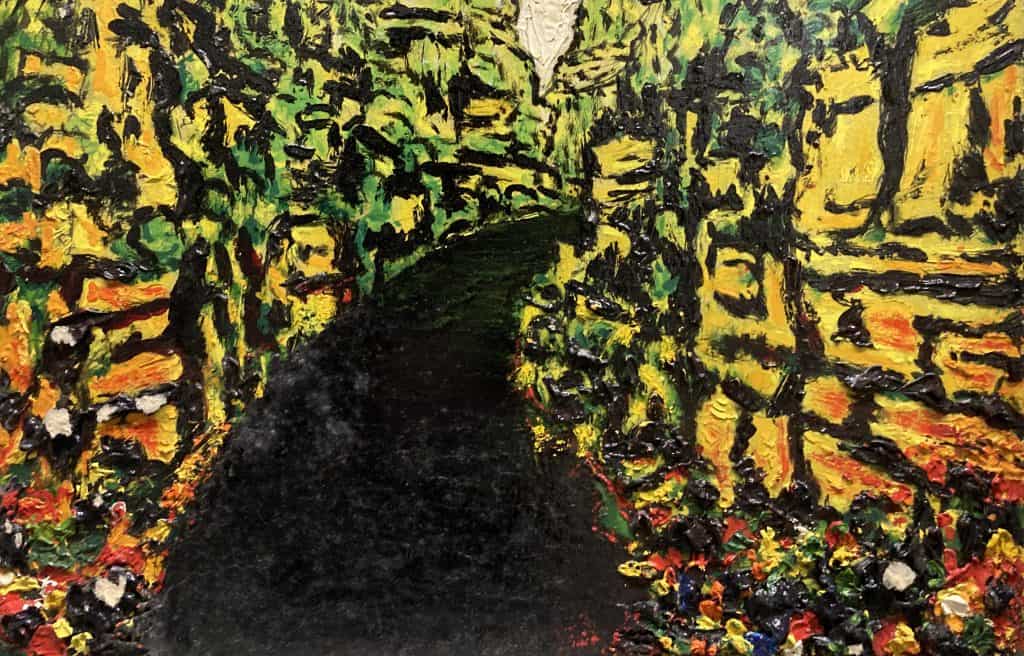
The painting depicts a view of the Doubs, a river in Central Europe that originates in France, flows along the border with Switzerland, and empties into the Saône. The Doubs is approximately 453 km long and is characterized by deep valleys, steep river cliffs, and numerous meanders. In this depiction, Evard focuses on a steep rocky coast, at the foot of which the river flows calmly. The expressive landscape is structured by restless, coarse forms, through which Evard renders the natural topography and texture of the rocks palpable. He portrays the Doubs itself in a deep black, almost menacing color, which further enhances the surrounding steep rock face into an abyssal representation. Like many paintings of this period, Evard uses paint in a pasty form, modeling the surface of the work almost like a relief.