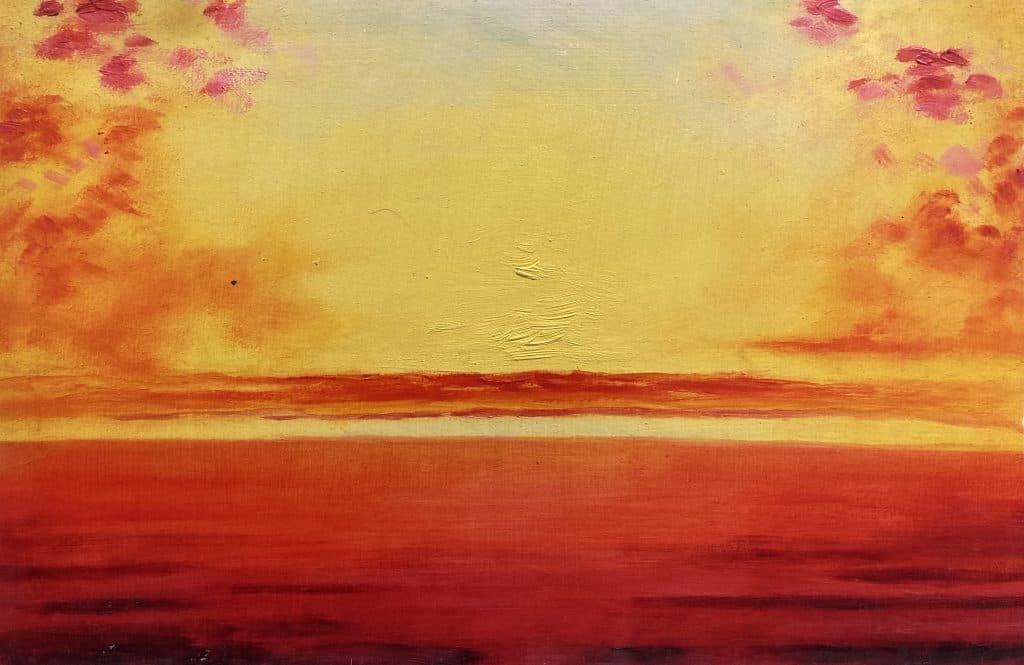
The painting demonstrates Evard’s distinctive ability to condense light and color into a comprehensive emotional experience. An almost transcendent landscape unfolds in warm, luminous tones: the sky glows in intense yellow and soft orange, which condenses into deeper layers of red and purple towards the bottom. The light seems to permeate the entire surface until there is hardly any distinction between heaven and earth—everything becomes a vibrating space of color.
The composition is strictly reduced and yet full of movement. The horizon forms a narrow, calm line that separates the luminous areas of color, while the upper sections break open into soft, cloud-like structures. Evard succeeds not only in depicting the energy of the sunset but in making it palpable—as a radiant symbol of transition, change, and hope.
The work was created in 1945, a time of profound upheaval. Europe lay in ruins after the Second World War, and many artists sought new forms of expression that led beyond destruction and suffering. Evard, who always worked on the boundary between representational and abstract art, translates this era of new beginnings into pure color and light. His sunset acts as a meditative response to the darkness of the preceding years—a quiet sign of renewal, peace, and the spiritual power of nature.
In the context of his complete oeuvre, this painting marks a late, mature phase: Evard increasingly detaches himself from concrete form and finds the actual means of expression in color itself. “Sunset in Yellow and Orange” is therefore not just a landscape, but also a vision of inner light—a silent triumph of color over the shadows of history.