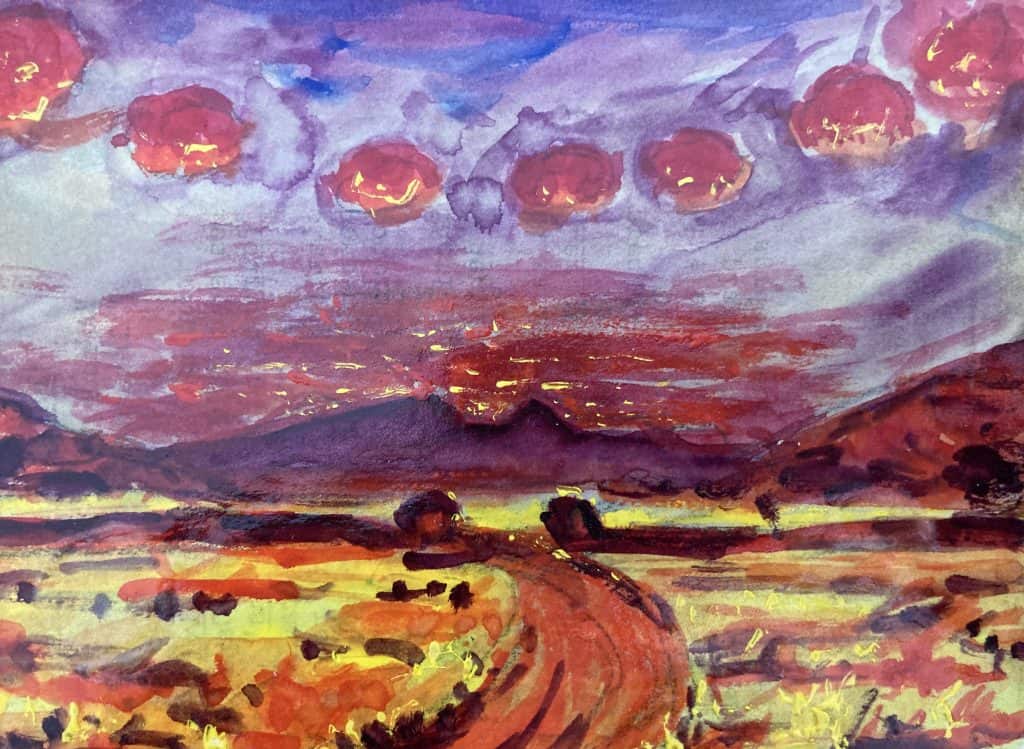
The painting depicts a luminous, almost expressively charged landscape: A winding path leads through a vast, golden-yellow and orange glowing plain towards a mountain range on the horizon. Above the mountains, a dramatic sky unfolds in intense forms that resemble floating suns or fireballs, lending the image a mysterious, almost cosmic atmosphere.
Here, Evard works with a luminous palette and energetic brushstrokes that dissolve the boundary between representational landscape and expressive abstraction. The color fields overlap, and the contours remain soft, so that the work is less oriented towards a true-to-life depiction and more towards the emotional impact of color and light.
Chronologically, the painting can be placed in Evard’s later creative phase, in which he returned more strongly to landscape painting after years of constructive, geometric abstraction. After the Second World War, many artists in Europe sought a new expression between inner emotion and formal freedom – Evard, too, found a lyrical-expressive visual language in this phase, in which color became the central carrier of mood.
The work can thus be considered an example of Evard’s late synthesis of Expressionism and Abstraction – a poetic vision of nature in which light, emotion, and form combine to create a harmonious, almost meditative unity.