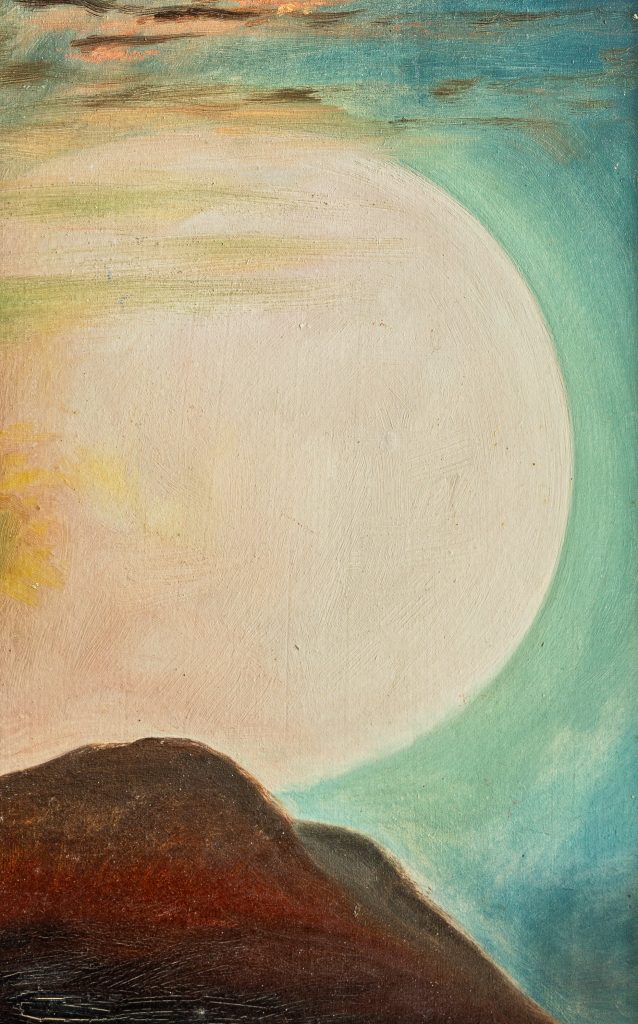
The full moon is the central focus of this 1919 work. Approximately two-thirds of the pictorial surface is occupied by the powerful moon; in the background, the blue sky is visible to the right, and beneath the moon lies a brown mountain, of which Evard depicts only the summit. It is striking that Evard—whose preference for symmetrical composition is well known—places neither the full moon nor the mountain centrally, nor does he depict them in their entirety. Instead, Evard presents a cropped full moon. Symbolically, the full moon represents perfection and completion. However, through this fragmentary depiction of the full moon, such perfection appears to be called into question. The mountain peak symbolically represents the overcoming of challenges and the attainment of goals, but also the connection between heaven and earth. Thus, this work seems to concern the search for completion, perfection, and transcendence. Can these be achieved through painting?