View into the spiral ascent, Hall 1, Powerlong Art Museum, Shanghai, China
On the occasion of the 150th birthday of the Swiss artist André Evard (1876–1972), Lea Qin Messmer (Director of Kunsthalle Messmer) and Jürgen Messmer (Foundation Board Member) opened the international exhibition “Realm of Color – Soul of Art” on June 12, 2026, at the Powerlong Art Museum in Shanghai, China die internationale Ausstellung. Die Ausstellung präsentiert 172 Werke aus der Sammlung der messmer foundation und würdigt das vielfältige Schaffen des bedeutenden Schweizer Künstlers. The exhibition is already considered one of the outstanding and particularly impressive presentations since the opening of the Powerlong Art Museum.
Among the countless guests were Dr. Norbert Riedel (German Consul General in Shanghai), Gregor Fritsche (Deputy Consul General of the Swiss Consulate in Shanghai), and Peter Weiß (former Member of the Bundestag and Social Election Commissioner).
The exhibition, which runs until September 20, 2026, features oil paintings, watercolors, gouaches by the artist from his four central groups of works: Art Nouveau, Still Life, Landscape and Abstraction. For the first time, entrepreneur, collector and founder of the Powerlong Art Museum, Xu Jinkang, is opening the otherwise exclusively reserved for his own private collection spiral ramp for a guest exhibition. Thus, the presentation of André Evard’s works also represents a special premiere for the Powerlong Art Museum.
From left to right: Lea Qin Messmer (Director, Kunsthalle Messmer), Jürgen Messmer (Founder, messmer foundation), Xu Jinkang (Entrepreneur, Collector, Founder), Wendy Jinkang (Director, Powerlong Art Museum).
At the exhibition opening, Lea Qin Messmer and Jürgen Messmer presented the entrepreneur,collector and founder of the museum, Xu Jinkang, and his daughter Wendy Jinkang (Director of the Powerlong Art Museum), with a significant work from the André Evard collection. The painting “Church against a Dark Background” (1925) was personally selected by Xu Jinkang for the museum’s collection and will remain permanently in China even after the exhibition ends.
Children's tour for under 6s with Lea Qin Messmer through the André Evard exhibition, Shanghai, China
The exhibition in Shanghai sees itself as a cultural bridge between Germany and China. The photo of Lea Qin Messmer during a children’s tour stands symbolically for the next generation and the future of this dialogue. In addition to the works of André Evard, the exhibition conveys art history in a lively and accessible way – especially for young visitors. Even in the first days of the exhibition, the immediate impact of the color-intensive works was evident: children and school classes stood fascinated in front of the paintings and, without any prior knowledge of art history, were inspired by the expressive power of the colors and forms. The exhibition thus impressively demonstrates that Evard’s art touches people across generations and opens up an intuitive access to abstract art. This creates a place of encounter, learning and intercultural exchange that connects people across borders.
In the first few weeks alone, the exhibition recorded more than 30,000 visitors from home and abroad, meeting with an exceptionally large international resonance. The festive opening was not only accompanied by high-ranking political representatives, but also closely followed by numerous international media productions as well as press representatives from all over the world.
Jürgen Messmer with Gregor Fritsche (Deputy Consul General, Swiss Consulate in Shanghai) during their joint tour through the exhibition
Jürgen Messmer (Foundation Board Member), Lea Qin Messmer (Director, Kunsthalle Messmer), Lu (Managing Director of the Powerlong Art Museum), Dr. Norbert Riedel (Consul General, German Consulate in Shanghai) with his wife and Peter Weiß (former Member of the Bundestag and Social Election Commissioner)
Powerlong Art Museum, Shanghai, China
With an impressive total area of approximately 23,000 m² divided into 11 exhibition spaces, the Powerlong Art Museum in Shanghai has established itself since its opening in 2017 as one of China’s most dynamic cultural institutions. Founded by Xu Jiankang with the vision of promoting traditional Chinese culture while giving new impetus to contemporary art, the museum uniquely unites past and present. As a non-profit private museum, the Powerlong Art Museum focuses on high-caliberexhibitions, international collaborations and a diverse educational program that makes art accessible to a broad audience. Generous, modernly equipped exhibition halls and impressive architecture create an immersiveart experience at an international level.
With its clear focus on cultural exchange and artistic innovation, the museum positions itself as a significant platform for dialogue between the Chineseand international art scene – and as a central driving force for the future of art in the 21st century.
Visit the website: http://www.powerlongmuseum.com/index.html?l=en-us
Messmer Foundation, Riegel am Kaiserstuhl, since 2005
The messmer foundation was founded in 2005 by former entrepreneur and art collector Jürgen Messmer. It is the supporting organization behind the kunsthalle messmer, which opened in June 2009 and has since served as an important venue for art education and cultural exchange.
The kunsthalle messmer stands out for its prominent location in the tri-border region and attracts international visitors from Switzerland, France and Germany. Every year, more than 60,000 people visit the Kunsthalle, which presents up to three high-caliber exhibitions in the field of Classical Modernism and contemporary art. Works from its own collection are shown alongside loans from international private and museum collections.
Since opening, the kunsthalle messmer has realized more than 53 groundbreaking exhibitions, including on Picasso, Miró, Dalí, Le Corbusier, Warhol and most recently Chagall, Niki de Saint Phalle, Le Corbusier, Hermann Hesse, etc.
A central part of the messmer foundation collection and commitment of Jürgen Messmer is the work of the Swiss artist André Evard (1876–1972). He founded Switzerland’s Concrete-Constructive style. Messmer’s connection to Evard began in 1974, when a major, important American collector drew his attention to him. Through research, including on site in La Chaux-de-Fonds, his enthusiasm for Evard’s multifaceted work deepened.
The collection at the messmer foundation is therefore one of the most extensive collections worldwide that manages, conserves and presents the artist’s works in internationalexhibitions.
Who is André Evard?
André Evard (born 1876 in La Chaux-de-Fonds, Switzerland, and died 1972 in Le Locle, Switzerland) was far ahead of his time – he was an early pioneer of abstraction when others were still clinging to the figure. Emerging from Art Nouveau, he developed an independent, constructive visual language during his artistic career and created an impressive oeuvre from which more than a thousand paintings, drawings, and watercolors emerged. He studied at the École d’Art in La Chaux-de-Fonds and attended courses with Charles L’Eplattenier, a former student of Ferdinand Hodler. In the circle of the avant-garde, with contacts to greats such as Le Corbusier and Theo van Doesburg, Evard worked uncompromisingly between abstraction and objectivity. The latter tried in vain to win Evard over to collaborate in the Dutch artist and design group “De Stijl.” Evard’s abstract, cubist, and constructive works, created during his Paris years, were shown at the Salon des Indépendants and the Salon d’Automne. In 1937, Evard joined as member no. 10 of the then newly founded artist group Allianz (the association of modern Swiss artists, founded by Richard Paul Lohse and Leo Leuppi).
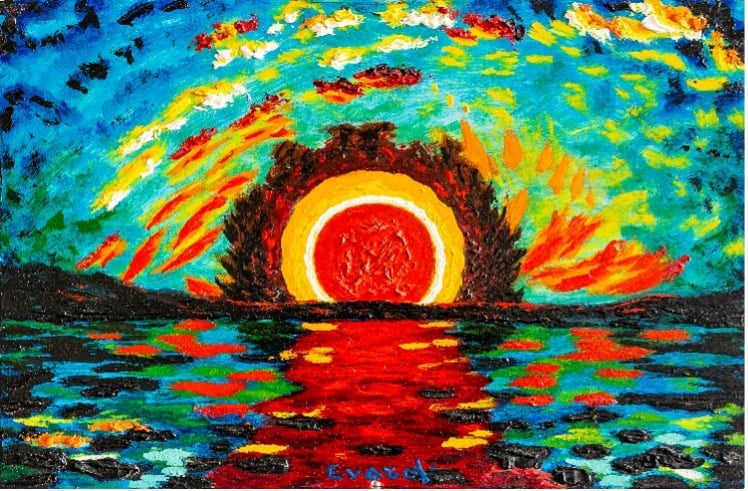
Evard never painted either – or, but always both at once: representational images that captivate with their intense coloring and radical abstraction in balanced harmony. His sunrises condense nature and landscape into expressive planes of color, in which light, sky, and forms already transition into the abstract. The romantic landscapes and the abstracted rose series also follow this movement of motif, color, and dissolution.
This very sunrise painting, which is shown at the Powerlong Art Museum, exemplifies this attitude:
André Evard, Sun Glow, 1960, oil on cardboard, 26.5x40.5cm
Why did we choose the Powerlong Art Museum?
Introduction to the exhibition "Realm of Color – Soul of Art" in Hall 1, Powerlong Art Museum, Shanghai, China
On the occasion of the 150th birthday of André Evard, the exhibition “Realm of Color – Soul of Art” (June 12, 2026 – September 20, 2026 at the Powerlong Art Museum, Shanghai, China)presents a total of 172 works by the artist in four central groups of works: Art Nouveau, Still Life, Landscape, and Abstraction.
End of the spiral tour in Hall 1, Powerlong Art Museum, Shanghai, China
The exhibition at the Powerlong Museum makes this field of tension spatially tangible. The spiral ascent, similar to the Guggenheim in New York, becomes the concept: as they ascend, visitors experience a simultaneous view. Across the open atrium, works face each other – landscape meets geometry, still life meets constructive composition. Not one after the other, but simultaneously.
André Evard in Hall 1, Powerlong Art Museum, Shanghai, China
To start: Evard’s Art Nouveau as a foundation. During the ascent, representational and abstract groups of works follow, such as classic still lifes and expressive landscapes; the hanging becomes more open, the view more free. Deliberately placed visual axes connect the levels – a silent dialogue between the images emerges. At the very top of the spiral, the abstraction section finds its conclusion in the abstract rose series, which forms the highlight of the exhibition. The tour ends with key works that conclude the exhibition as examples of the work groups.
Tour of Hall 1, Powerlong Art Museum, Shanghai, China
“Realm of Color, Soul of Art“ at the Powerlong Art Museum, Shanghai, China (2026-06-12 – 2026-09-20) builds an impressive bridge between Europe and China while simultaneously opening up a special educational approach to Western visual language through the works of André Evard.
After their presentation in Shanghai, the 172 works will return to the Kunsthalle Messmer for the major anniversary exhibition from October 17, 2026, to April 18, 2027. There, they will enter into an exciting dialogue with works by significant artistic figures such as Paul Klee, Willi Baumeister, and Max Ackermann, continuing the tribute to André Evard within an expanded art-historical context.
Those who cannot visit the exhibition at the Powerlong Art Museum in Shanghai by September 20, 2026, will have the special opportunity starting October 17, 2026, at the Kunsthalle Messmer to experience this extraordinary artistic bridge between the past, present, and international cultural spaces for themselves to experience.
Further photos can be found at the following link: