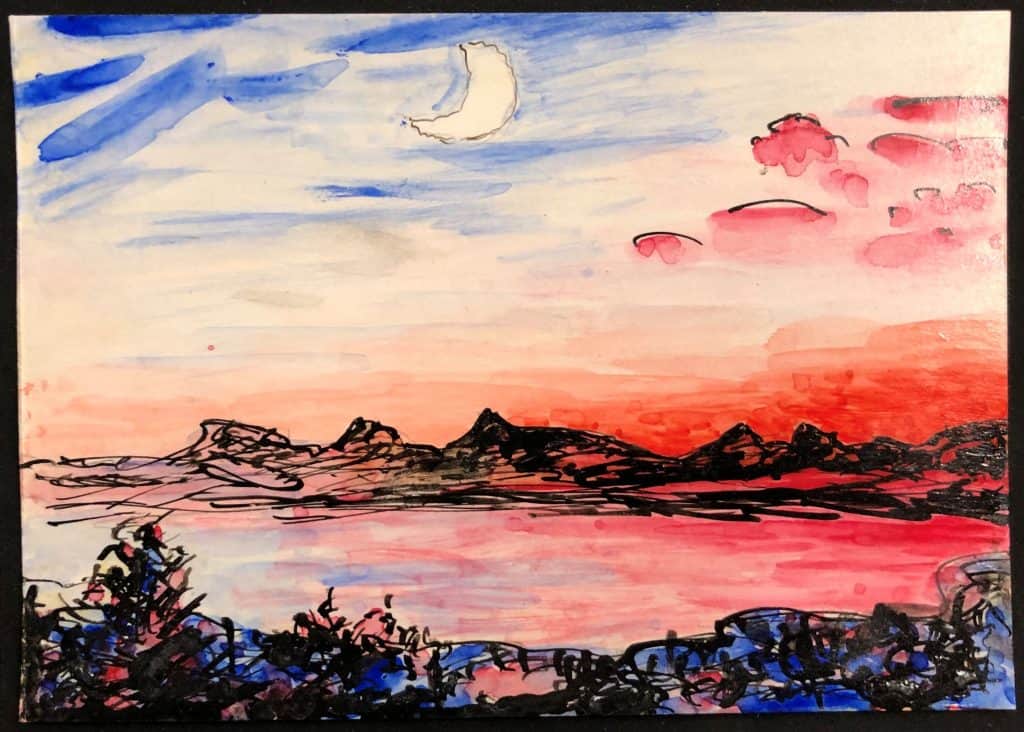
André Evard’s (1876–1972) work Moon over Lake from 1971 presents a poetic, highly reduced landscape depiction that mediates between representational art and abstraction. Executed in oil on paper, the picture unfolds a distinctive chromatic effect: cool blue tones in the sky meet an intense, almost glowing red on the horizon, which is reflected in the water. These contrasts create an atmosphere that is full of tension yet calm. The dark silhouettes of the mountains and the suggested vegetation in the foreground are captured only sketchily and appear more like signs than concrete forms.
Typical of Evard’s late work, the focus is less on a realistic depiction of a place than on an inner, subjective landscape. The soft transitions and flowing contours make the scene appear detached, almost dreamlike. The moon, placed small and unobtrusively in the sky, serves as a symbol of silence, reflection, and time. In conjunction with the lake, which mirrors the colours while simultaneously suggesting depth, a pictorial space emerges in which external perception and inner sensation overlap.
Philosophically, the work can be read as the depiction of a transitional moment—between day and night, clarity and feeling. The luminous red can be understood as a sign of intensity or transience, while the calm moon adopts a detached, almost timeless perspective. Thus, the picture does not capture a fixed place, but a fleeting state: a quiet, contemplative moment in which emotion and perception dissolve and merge into one another.