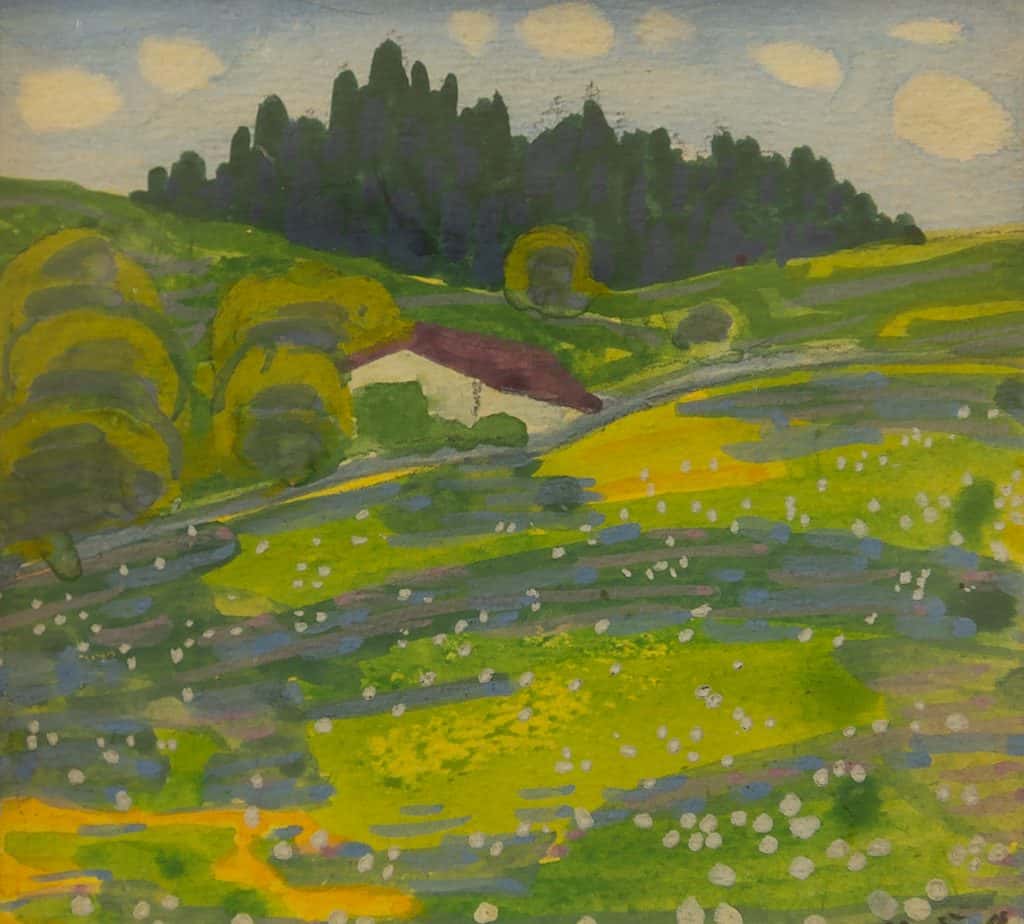
The painting depicts a vibrant, serene scene in which a hilly meadow unfolds in lively shades of yellow, green, and blue. Small white blossoms run through the surface, lending it a shimmering lightness. Between softly placed groups of trees lies a small house, half concealed, and in the background a dark, seemingly continuous strip of forest stands in strong contrast to the bright foreground landscape. The sky, with its gentle white clouds, creates a calm sense of openness and completes the harmonious, slightly stylised depiction.
From an art-historical perspective, the work can be assigned to Evard’s late creative phase, in which, after decades of engagement with concrete abstraction, he returns once again to representational landscape. His characteristic formal language remains clearly perceptible: nature is not rendered naturalistically, but conceived in clearly structured, almost mosaic-like fields of colour that recall the constructive principles of his earlier abstract works. In this way, Spring Landscape combines the lyrical mood of nature in bloom with a structured, deliberately composed pictorial order—an exemplary instance of Evard’s synthesis of abstraction and figuration in the 1950s and 1960s.