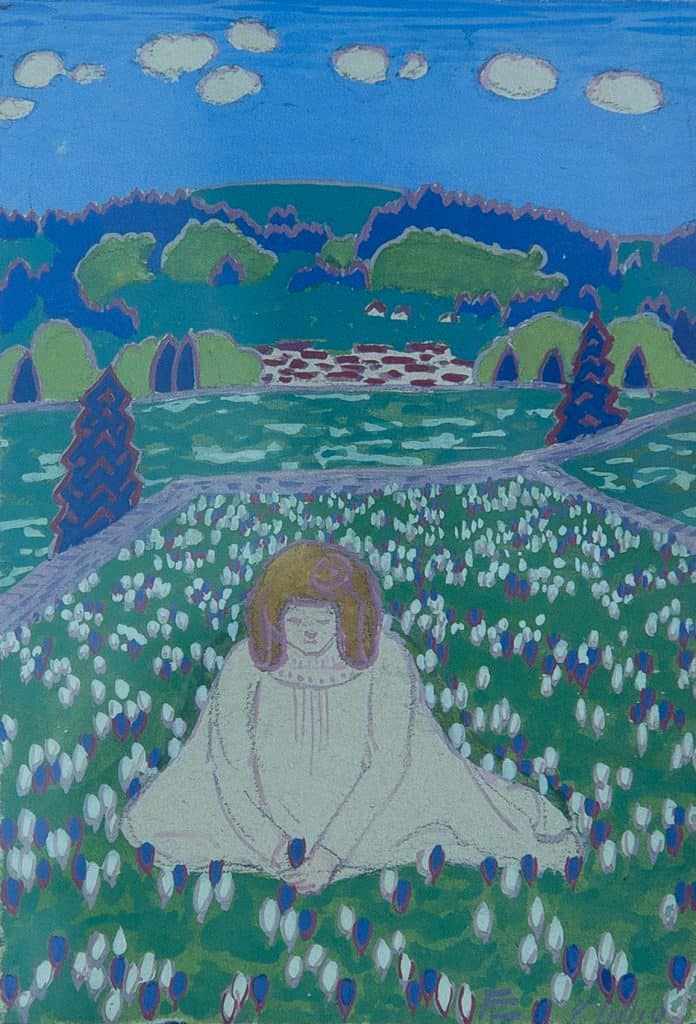
Evard’s painting “Girl in a Flower Meadow” (1910) unfolds a quiet, almost dreamlike scene of great poetic impact. At the center of the composition sits a young girl, lost in thought, surrounded by a lush, blooming meadow. Her bright, softly flowing body seems almost to merge with the landscape, as if she were a natural part of this peaceful environment.
The flowers, depicted in dense, rhythmically placed dabs, spread like a living carpet across the entire foreground. Their colors – delicate white, blue, and violet tones – form a gentle contrast to the rich green of the meadow. Behind them, the landscape opens up into gentle hills and stylized groups of trees, which, through their simplified forms and clear contours, create a decorative effect. A small village with red roofs is nestled in nature, lending the scene additional depth and security.
The sky above appears in a calm blue, traversed by softly shaped, almost ornamental clouds. The entire color scheme is bright and flat, giving the painting a certain timelessness and proximity to Symbolism.
Here, Evard succeeds in creating a tranquil world through reduction and harmony, reflecting less the external reality and more an inner mood. The painting radiates calm, innocence, and a gentle melancholy – an invitation to immerse oneself for a moment in an idealized, peaceful nature.