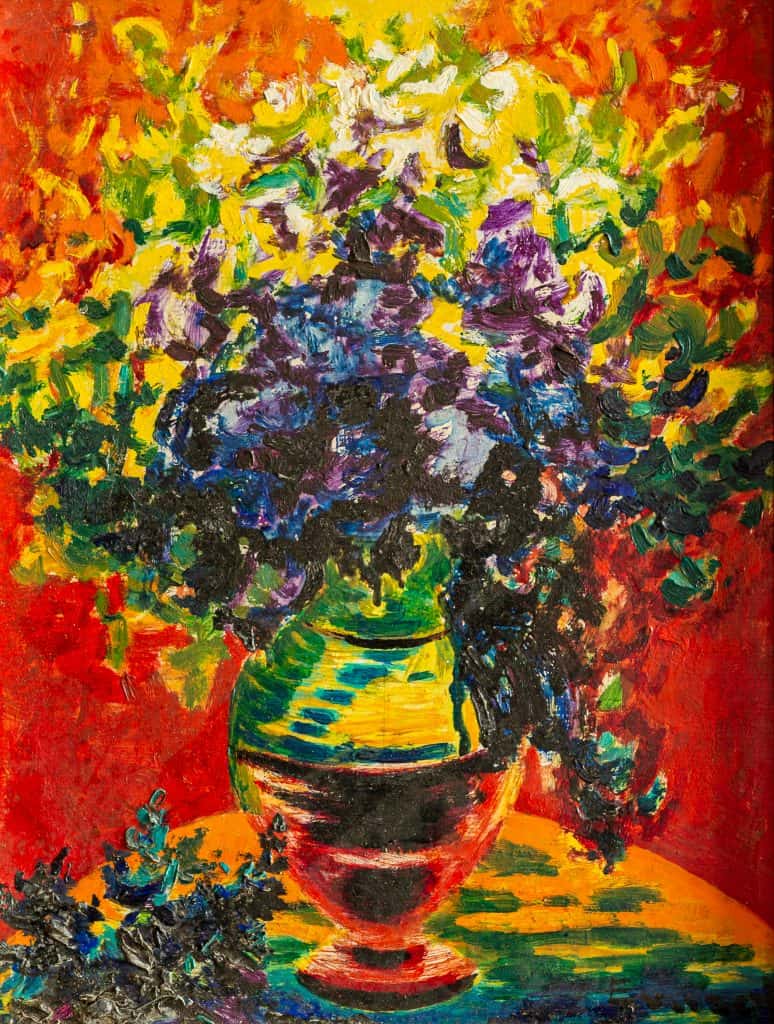
In the work “Bouquet of Flowers” from 1951, André Evard unfolds his long-standing engagement with color, form, and pictorial composition. The dense bouquet in strong, saturated colors creates a striking color contrast with the pictorial environment: The blossoms appear cool and calm, while the background creates an intense spatial tension through warm red/orange tones.
Evard consciously employs this cool-warm contrast as a compositional device: The cool bouquet visually advances, gaining proximity and presence, while the warm background recedes—the still life thus acquires depth, three-dimensionality, and an almost theatrical effect. In this color arrangement, one can recognize Evard’s ability to perceive opposing colors not as a disturbing contrast, but as a harmoniously dynamic unity—a quality that permeates his entire œuvre.
Furthermore, the painting points to Evard’s lifelong search for expression and mood through color: Although the artist found his way to geometric abstract art early on, he repeatedly returned to figurative painting—particularly in small still lifes and nature depictions, where color and mood often take center stage. Such a flower painting demonstrates how Evard combines classical motifs with his modern sensibility for color and composition.