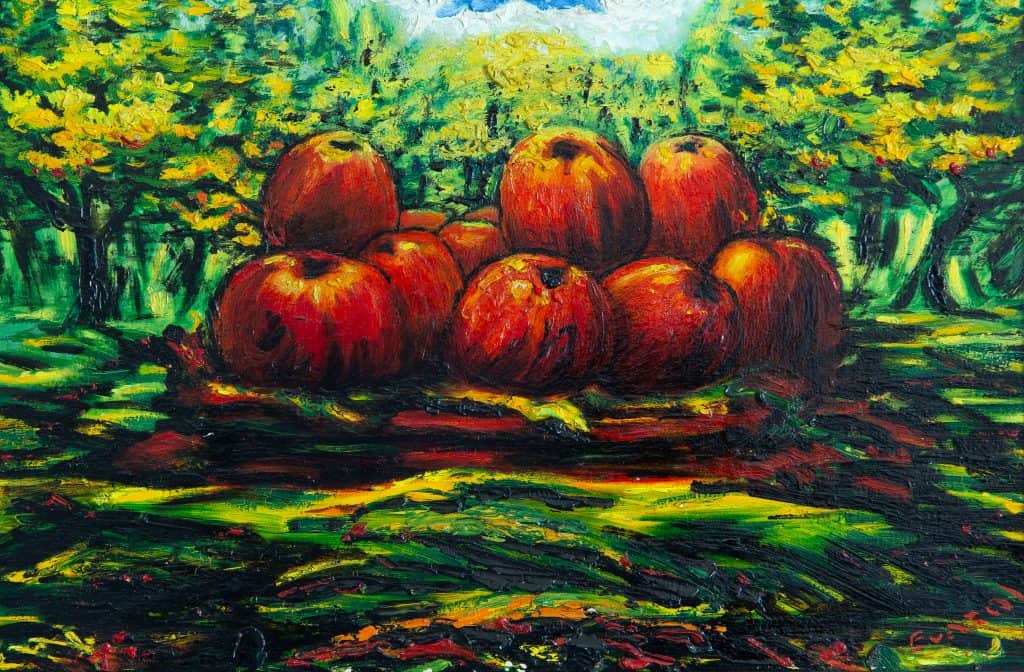
The painting depicts a group of luminous red apples arranged in an almost monumental manner in the foreground. The fruits appear heavy, compact, and are modeled through strong light-shadow contrasts. Their rounded forms stand out clearly against the dynamic, expressive background. This is characterized by intense green tones and yellowish shimmering areas that suggest a garden-like setting. The brushstrokes are dynamic and multilayered, in places almost impasto, so that the ground and foliage appear in vibrant motion. A certain dramatic atmosphere pervades the contrasting colors, making the apples the main protagonists of a powerful natural ensemble.
The work can be classified within Evard’s late phase, in which he returned more strongly to the representation of nature after his strictly constructivist, almost purist pictorial compositions of the 1920s and early 1930s. Evard, one of the early representatives of Swiss Concrete art and often situated within the context of modernist avant-gardes, combined representational motifs with a distinctly expressive use of color in his later works. Particularly in the 1940s, a period marked by political and social upheaval, Evard increasingly turned to an intense, emotionally charged manner of painting in which color served as the central means of expression.
In this painting, his particular ability to transform the genre of still life into an expressive, almost symbolic form becomes evident. The apples appear not merely as naturalistic fruits, but as energetic color elements that are elevated from their surroundings and radiate an inner force. The composition appears condensed and charged with tension, although it does not represent a real space, but rather a color-saturated resonance space reminiscent of expressionist landscape painting such as that of Vincent van Gogh (1853–1890).