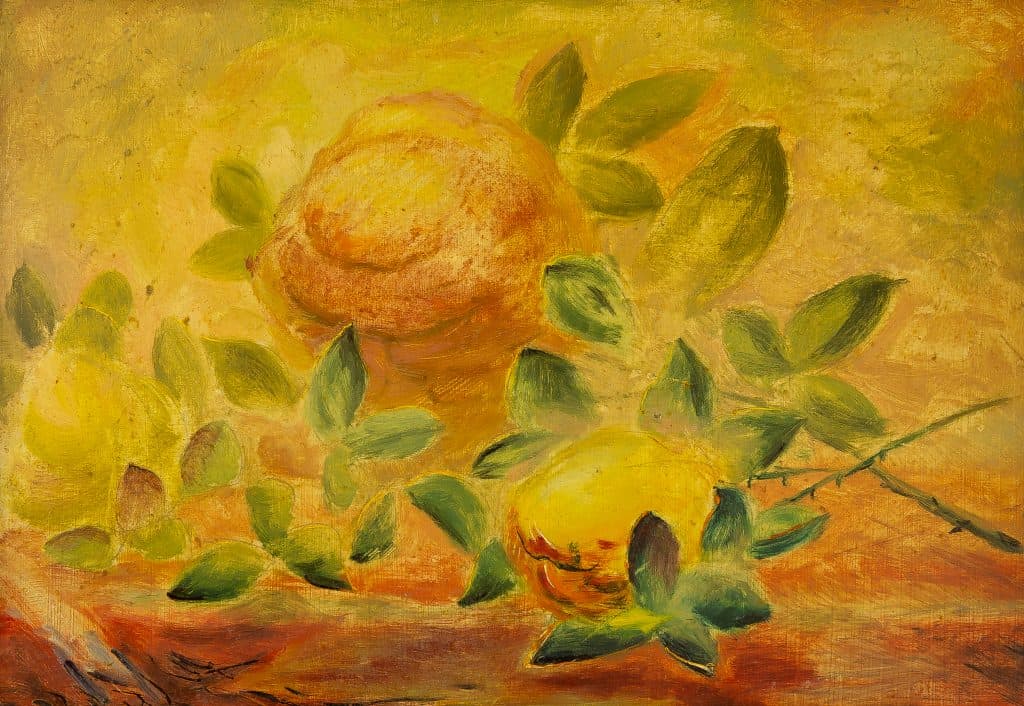
This still life clearly reveals Evard’s turn toward the expressive use of color and form characteristic of early modernism. The roses, modeled in warm shades of pink and yellow, are not naturalistically rendered in detail but appear deliberately simplified and softly contoured. This painterly treatment reflects Evard’s engagement with Post-Impressionism and early Expressionist movements, in which color and atmosphere gain significance over precise botanical representation.
The foliage is rendered in loose, rhythmically placed green tones, lending the floral arrangement a lively movement, while the background is composed of impasto, blurred color fields. This creates an almost floating, poetic effect that elevates the still life beyond the purely decorative genre and places it within the context of a modern, subjectively informed pictorial conception. The composition demonstrates Evard’s interest in the balance between structure and delicacy—a characteristic that would later shape his path into constructive and abstract painting.