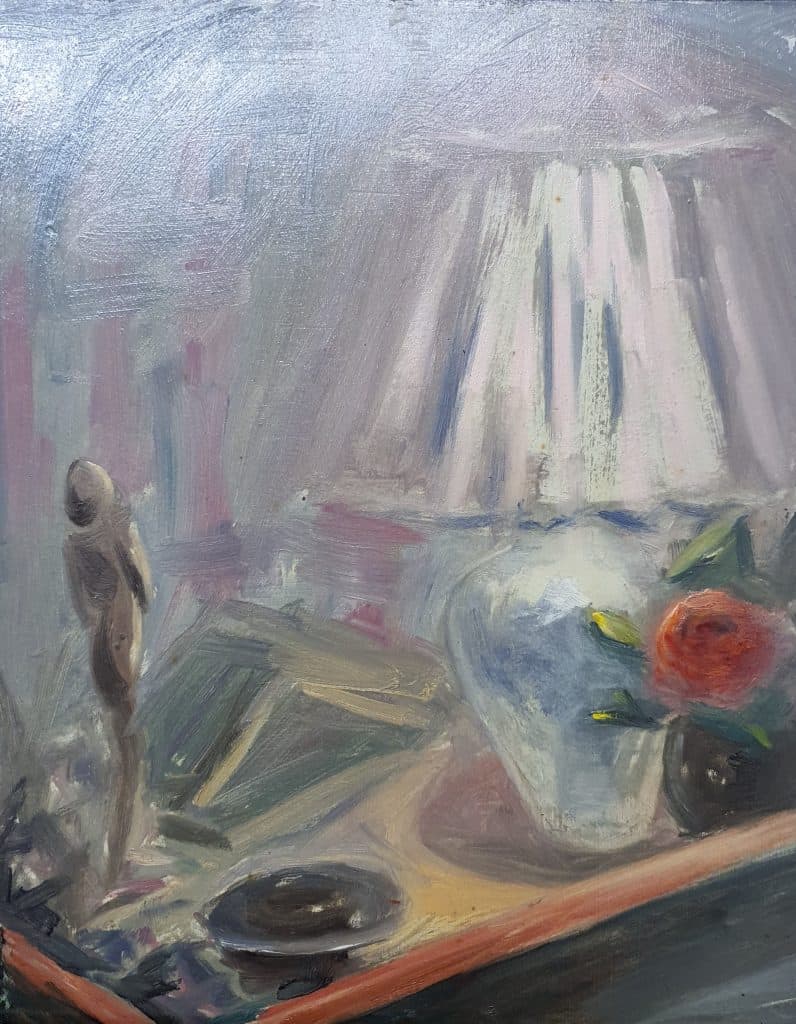
This still life depicts an intimate interior scene, where light and form assume the central design role. On the table stands a white table lamp, as well as a red rose, whose intense hue creates a strong contrast to the otherwise cool, pastel palette. To the left is a small, abstracted figure, which appears like a reduced sculpture and lends a quiet, almost symbolic presence to the painting.
The work can be classified into Evard’s transitional phase between Late Impressionism and an increasingly abstract formal language. The loose, broad brushstrokes and the dissolution of material contours in the light are reminiscent of Impressionistic techniques, while the concentration on basic geometric forms – especially in the structure of the table – already points towards constructive tendencies that Evard would later pursue more consistently.
The composition thus combines atmospheric light sensitivity with a structural clarity, which is typical of Evard’s search for his own path beyond strictly representational painting.