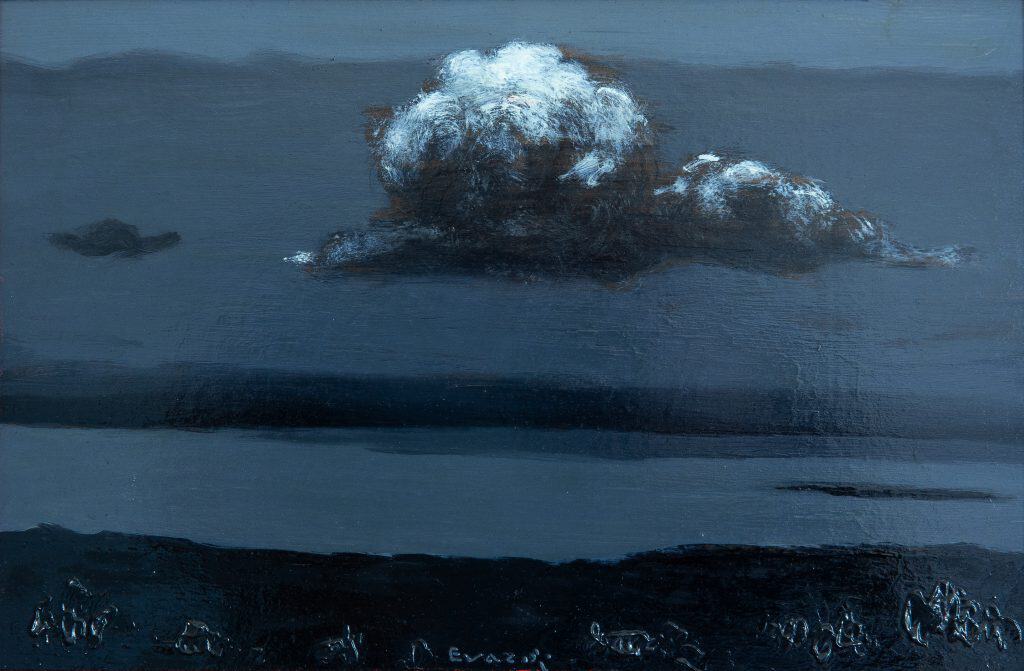
The painting depicts a quiet, atmospheric scene rendered in muted shades of gray. In the foreground lies a dark strip of shoreline that clearly defines the bottom of the image and transitions into a calm body of water. The water appears mirror-smooth, enhancing the peaceful mood of the work. Above the clear horizon, a vast sky opens up, at the center of which floats a large, sculpturally modeled cloud. Its lighter shades form a striking contrast to the restrained colors of the surroundings. Smaller cloud fragments accompany it, emphasizing the expanse of the nocturnal sky. The entire composition appears orderly and balanced, radiating a sense of profound tranquility.
Chronologically, the work belongs to a phase in which Evard—one of the early representatives of constructive and concrete art in Switzerland—continued to work between abstraction and representationalism. In the 1950s and 1960s, he favored a reduced, harmonious color palette and clear structures, which is reflected in this landscape. The simple, concentrated visual language is in keeping with post-war art trends that emphasized peace, order, and clarity instead of expressive drama. Thus, in this work, Evard combines a poetic depiction of nature with the formal rigor of his constructive approach.