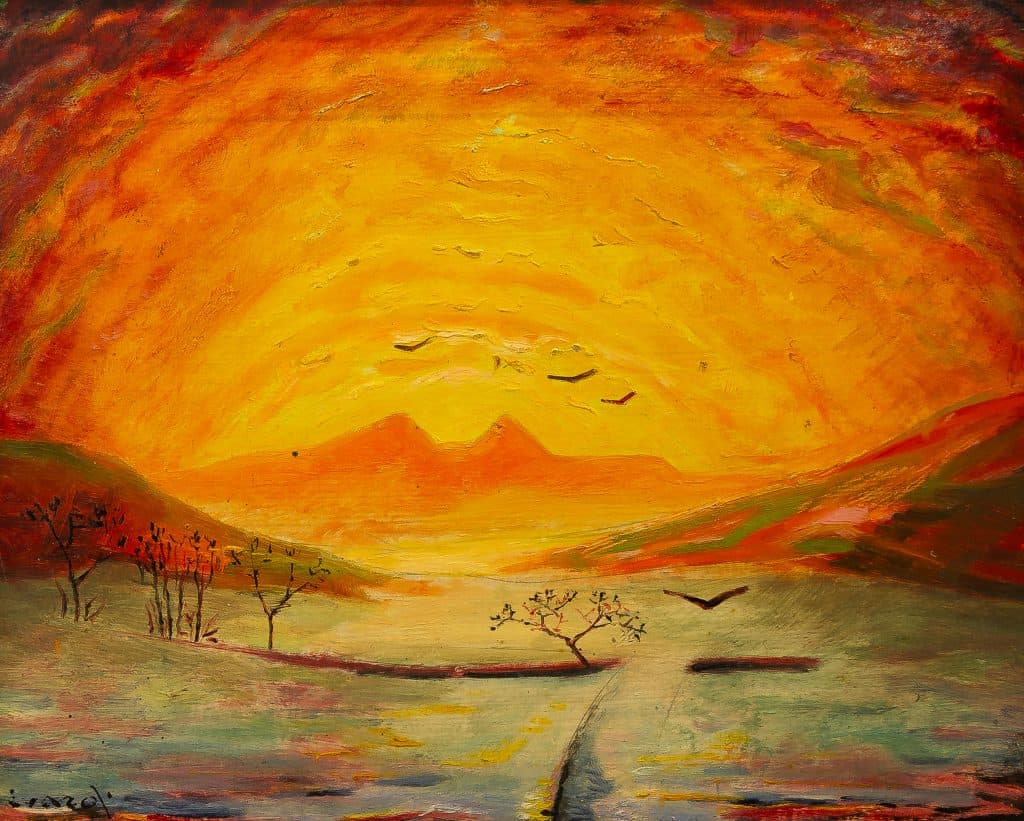
The oil painting depicts a landscape in intense shades of yellow, orange, and red. At the center of the image is a large, radiant sunset, whose rays spread in circular form across the entire sky. In the foreground, one can make out a barren landscape with bare, almost withered trees. A few birds fly in the distance over the mountains—a motif that suggests movement and hope.
The choice of colors in the composition conveys a dual mood: on the one hand, the warm light of the sunset appears peaceful and hopeful—a symbol of an approaching end and perhaps also of a new beginning. On the other hand, the bare trees and the empty landscape evoke destruction, loss, and exhaustion. This ambivalence can be readily interpreted in the historical context of the year of its creation, 1918: the end of the First World War. (1914-1918) Here, Evard may have deliberately understood the setting sun as a metaphor for the end of the war—a chapter full of suffering, devastation, and death that is now slowly coming to an end. At the same time, the light on the horizon heralds hope for peace and renewal.
Overall, the painting feels like a quiet moment between end and beginning: the pain of what has passed and the cautious hope for a better future.