


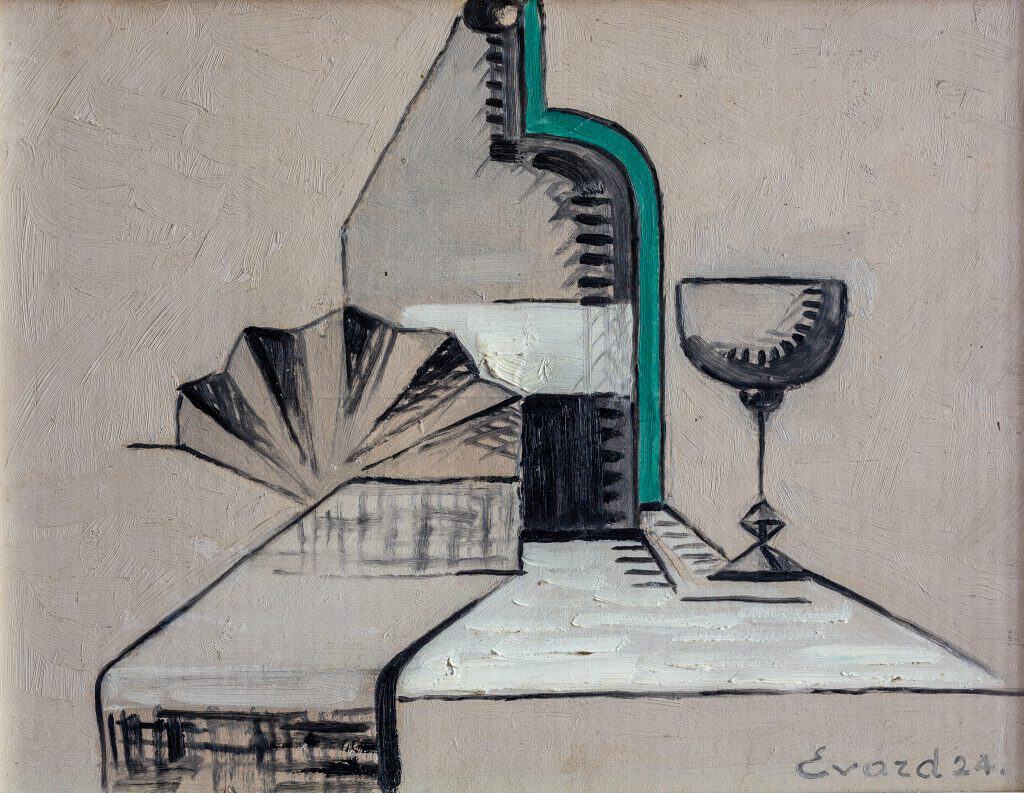
The work presents a strongly simplified, constructively structured composition of a bottle, a glass, and a fanned-out napkin. The objects are reduced to lines, planes, and contours, creating an abstracted, sketch-like impression. The restrained palette of grey, beige, and white tones is interrupted only by a striking turquoise line that lends the still life rhythm and structural tension. Evard dispenses with illusionistic modelling and develops the forms solely through relationships of planes and linear articulation.
In art-historical terms, the work stands in the field of tension between synthetic Cubism and the emerging Concrete Art, among whose early representatives Evard is counted. The still life marks a transitional phase in his oeuvre: the motifs are still recognisably representational, yet are already treated according to principles of constructive order and formal reduction. In this way, the painting combines Cubist dissolution of form with the clear, structural rigour of the abstract avant-gardes of the 1920s, and shows Evard’s path towards his later geometric pictorial vocabulary.