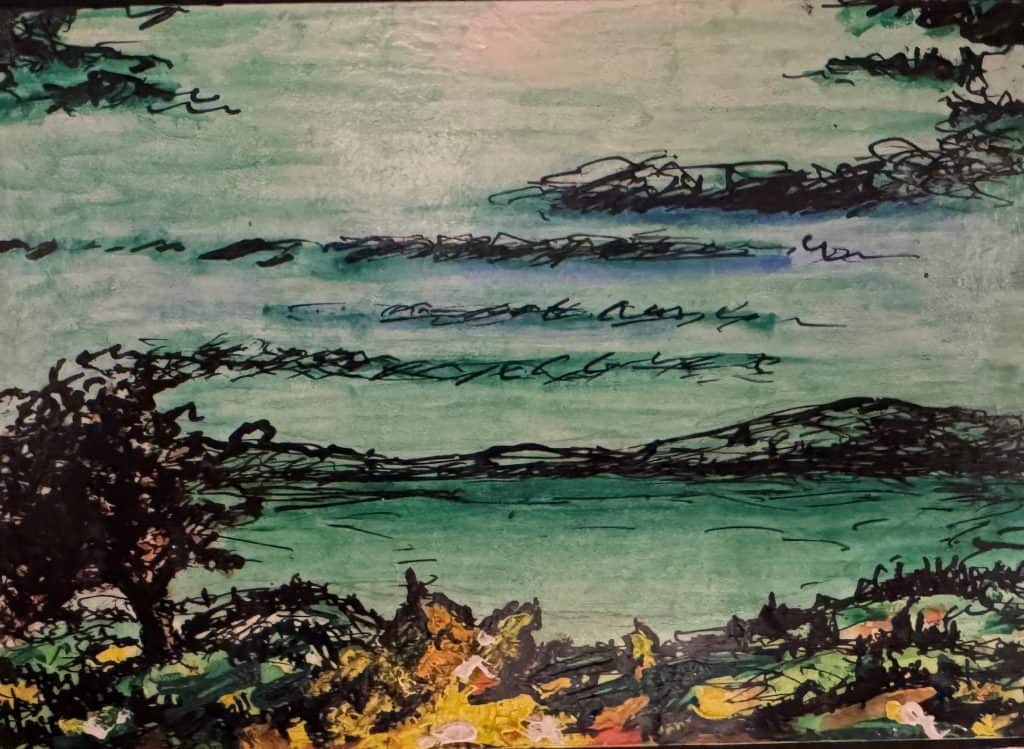
André Evard’s (1876-1972) 1969 work, Green Dream, depicts a tranquil, yet vibrantly structured landscape, strongly dominated by the color green. Executed in gouache on paper, the painting reveals a matte, velvety color effect, where the tones appear flatter and more opaque than, for example, in oil. Various shades of green – from light, almost pastel tones to deeper, saturated hues – are layered in horizontal zones, creating a vast, slightly abstracted landscape. Dark lines and contours punctuate these layers, appearing like sketchy outlines of trees, hills, and clouds.
The depiction is significantly reduced, oscillating between suggestion and dissolution. Individual elements such as a tree in the foreground or distant terrain lines are discernible, yet they lose their fixed form in favor of a rhythmic interplay of lines and surfaces. The space does not appear strictly perspectival, but rather layered, almost like fragmented memories of a landscape. This creates less the impression of a concrete place and more of an inner vision.
Philosophically, the painting can be interpreted as an expression of a quiet, contemplative experience of nature. The predominant green traditionally symbolizes growth, renewal, and tranquility, but also a certain detachment – like a dream state in which the world appears familiar yet altered. The title “Green Dream” reinforces this interpretation: the landscape does not feel real, but rather perceived. Evard seems to be depicting less external nature and more an inner mood here – a balance between perception and memory. Thus, the painting becomes a quiet, poetic space where nature and emotion are inextricably linked.