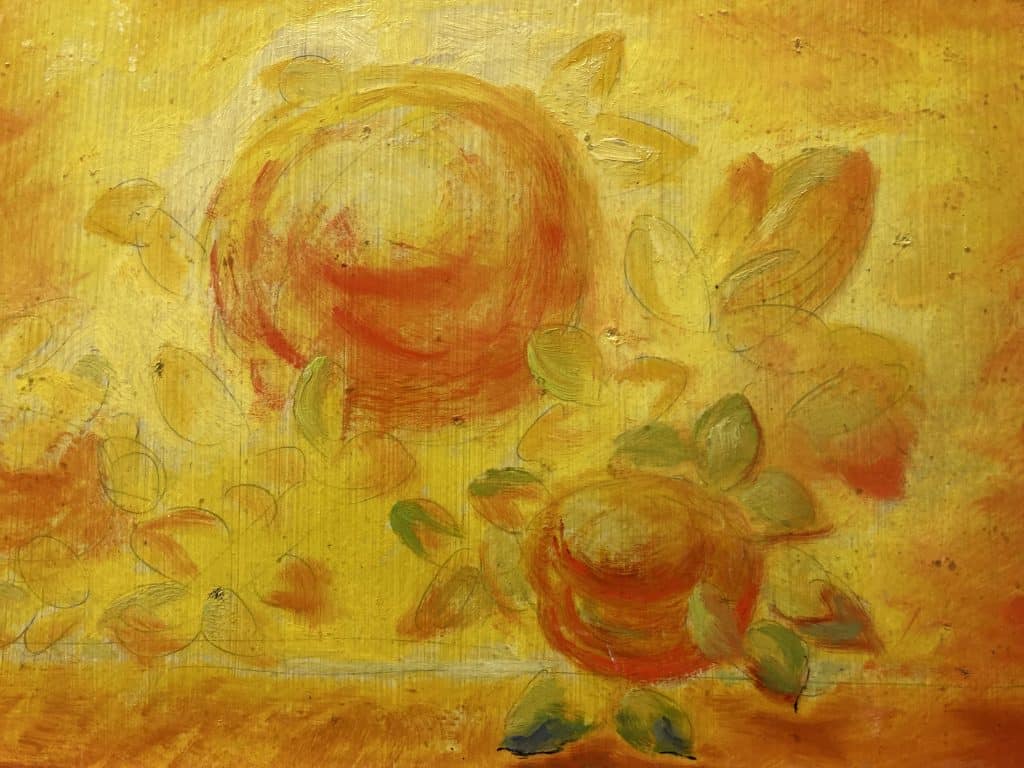
This work also strikingly depicts roses lying down. Both works, “Lying Roses” and “Peonies in Orange Light,” date from 1919 and show how intensively Evard engaged with floral still life during this period—yet in an increasingly modern, colour-focused visual language. In terms of motif, they are linked by the lush forms of the blossoms, which Evard interprets less naturalistically and more atmospherically and painterly.
“Lying Roses” employs a varied, slightly muted palette of rose, yellow and green tones. The mood appears calm, and the blossoms stand out more clearly from the background.
By contrast, “Peonies in Orange Light” appears as if bathed in a warm, almost glowing light. Yellow, orange and golden tones dominate here, giving the entire pictorial field a radiant, almost monochromatic intensity. This luminous glare causes the forms to merge more strongly with one another and creates an almost Symbolist effect.
Both paintings exemplify Evard’s development after the First World War (1914–1918), when he increasingly turned to modern tendencies. While “Lying Roses” still connects to traditional still life, yet already works with chromatic simplification, this work goes a step further: here, colour becomes the true protagonist and foreshadows Evard’s path towards a freer, increasingly abstracted formal language. Both works illustrate how, in this phase, Evard explores transitions between naturalistic depiction, expressive use of colour and atmospheric abstraction.