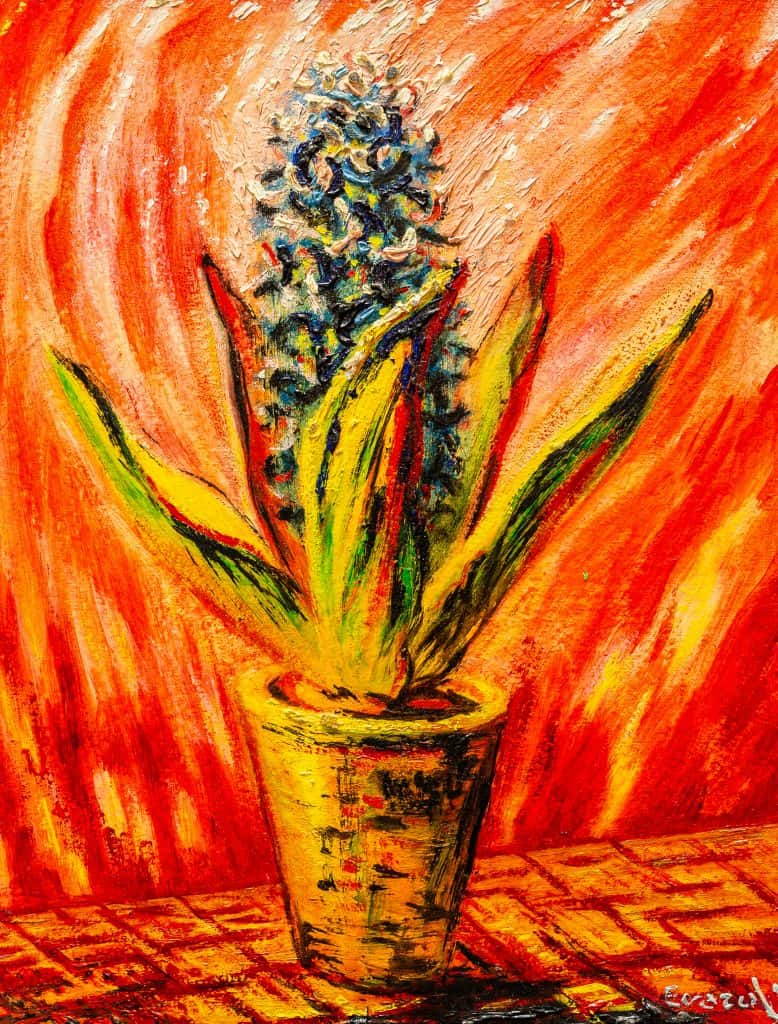
In “Blue Hyacinth” from 1940, André Evard combines classic still life motifs with expressive dynamism. The central hyacinth, with five upright green leaves, rises from a pot. The blossoms, in rich blue and violet tones, are applied with loose, dabbing brushstrokes. The diagonally positioned table with a raffia pattern and the blazing background in shades of orange, red, and yellow echo the movement of the foliage, making the image appear vibrant.
Through this color palette and the almost flaming lighting, Evard transforms the traditional still life into a vivid visual impression that draws the viewer directly into the painting.
In the European art tradition, the hyacinth represents spring, rebirth, and transience. Created in 1940 in La Chaux-de-Fonds, the work also reflects the particular circumstances of the European art market during World War II (1939–1945). While the region was less directly affected by the political and economic turbulence of the time than the major metropolises, it served as an important sanctuary for artists and collectors. Moving within this environment, Evard was able to develop an independent artistic language that spanned the gap between representationalism and abstraction. At the same time, the local art market was characterized by a selective demand for small-format, portable works, such as “Blue Hyacinth.”