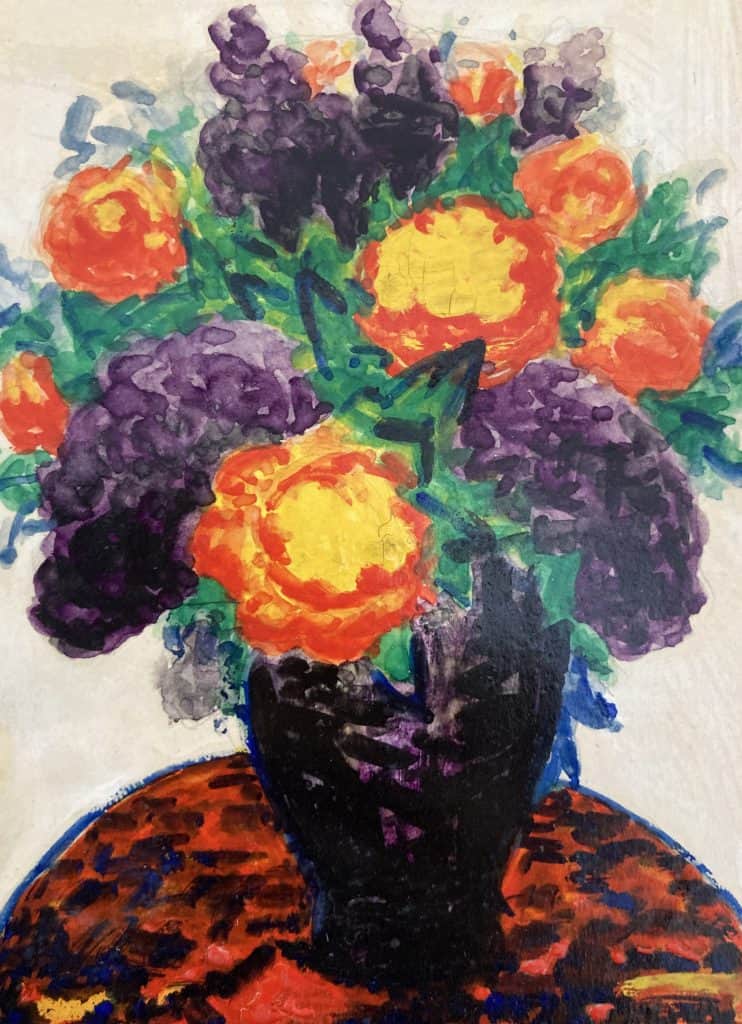
The work depicts an opulent bouquet of orange and deep purple blossoms in a dark vase, positioned centrally against a neutral background on a patterned, round table. The bold color accents of the vibrant orange flowers stand in strong complementary contrast to the dense, heavy purple blooms, creating a tension-filled color drama. The gouache technique gives the surface a matte yet rich color effect, which clearly contours the shapes and lends them a compact presence. Gouache is a water-based opaque painting technique in which colors are applied opaquely, boldly, and matte, allowing for both fine details and luminous surfaces.
The table, with its warm, mottled pattern, serves as a stable pictorial ground and enhances the color intensity of the bouquet.
In this work, Evard increasingly moves away from earlier experimental movements such as Cubism and Constructivist reduction. Instead, he turns toward a decorative, color-emphasized figuration. Even if the still life appears traditional at first glance, Evard’s characteristic structuring of the composition is evident: a clear central perspective, a balanced interplay between flatness and volume, and a deliberate emphasis on color masses.
In the post-war period, Evard increasingly sought harmonious, color-intensive motifs, as this work impressively demonstrates. The dense, almost mosaic-like placement of the color planes also points to his lifelong engagement with ornament, structure, and formal stability. Thus, the painting combines traditional still-life painting with Evard’s unmistakable sense of constructive order and luminous coloration.