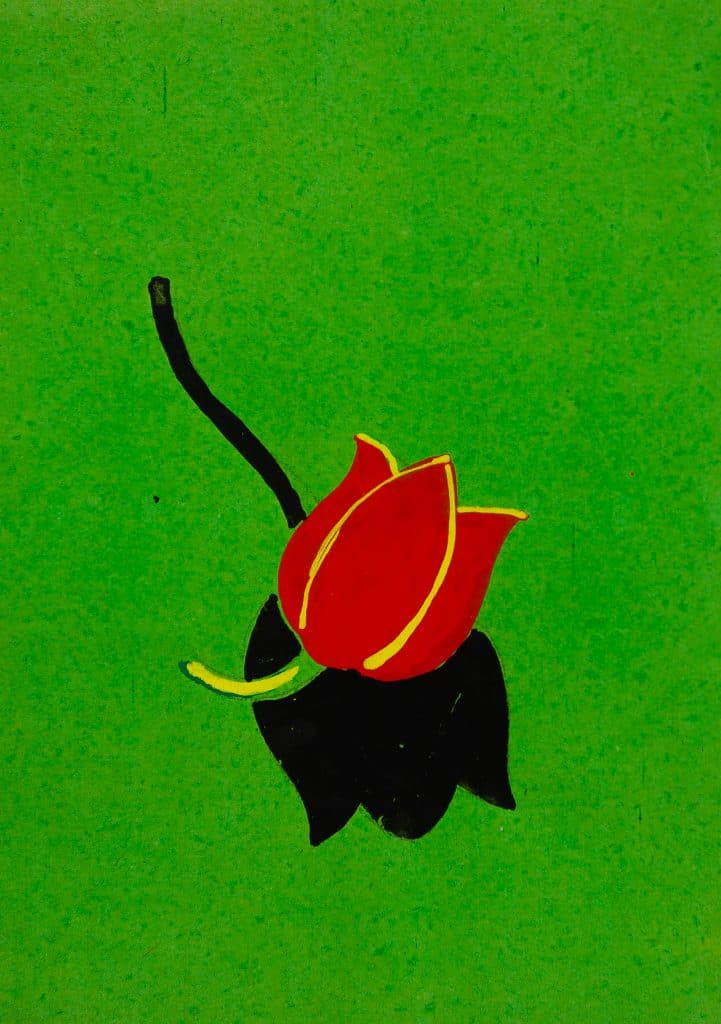
This small-format work presents a single floral motif that unites both naturalistic and stylized elements. Against a monochrome green background appears a red tulip blossom that, in its simplification, takes on an almost emblematic quality.
The blossom itself consists of clearly delineated, red-edged petals whose contours are accentuated by fine yellow lines. These lines lend the motif graphic precision and point to Evard’s constructive and ornamental forms of expression. The reduction to a few forms and the clear contours reveal his affinity with constructive modernism, without transforming the motif into the abstract. The plant remains recognizable, yet is highly formalized.
The black stem and the dark, almost silhouette-like form beneath it effectively set the luminous blossom in scene. The interplay of light and dark allows the tulip to emerge from the background and lends it an almost iconic presence.
The composition is deliberately asymmetrical: the blossom is positioned slightly to the right within the pictorial field, creating a subtle tension. At the same time, the motif appears calm and concentrated through its clear formal language. Here Evard employs reduction as a means of condensation—the tulip is presented not as a botanical object, but as a formal idea, as a visual sign.
Stylistically, the work stands between symbolic simplification and constructive formal awareness. While the color fields and lines recall decorative movements of the 1920s and 1930s, the stylized clarity already reveals Evard’s later interest in more rigorous compositions. The choice of the floral motif fits into his lifelong engagement with natural forms, which he repeatedly penetrated through abstraction.