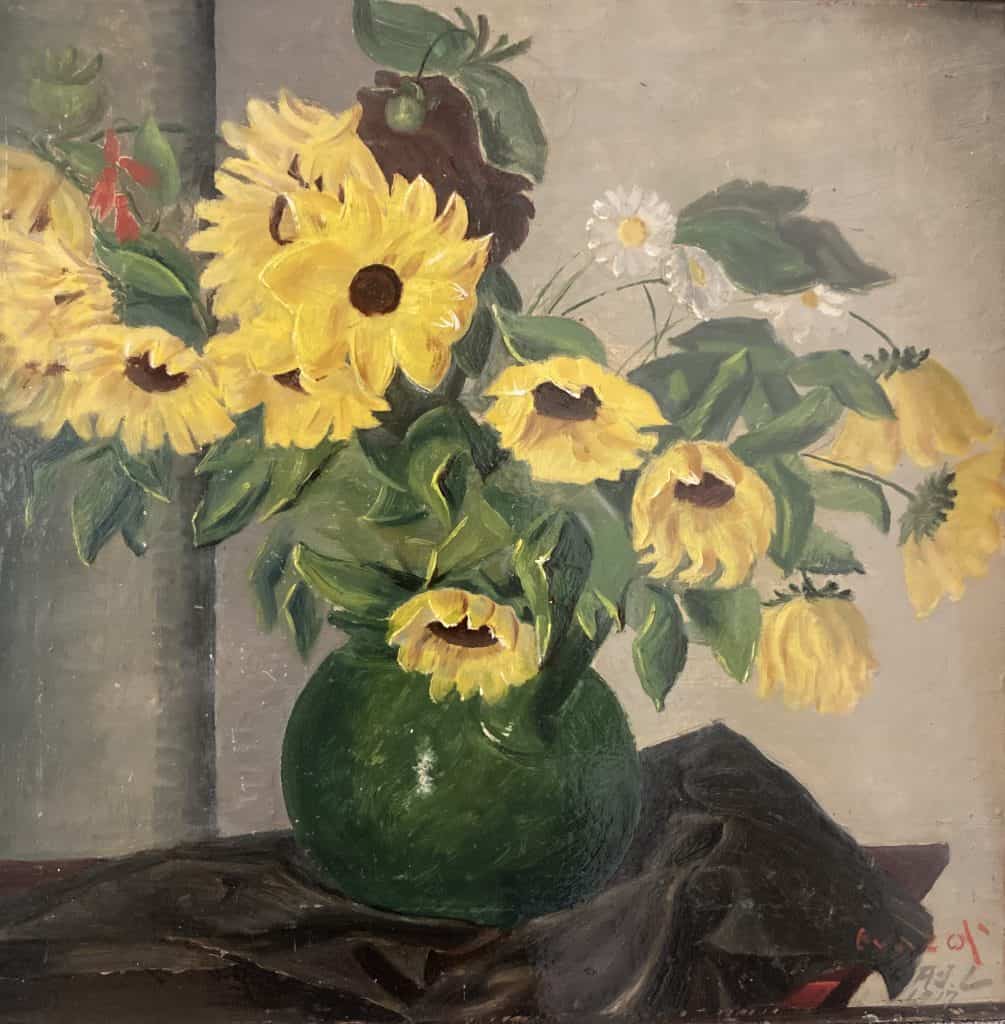
The painting depicts a floral still life that, at first glance, adopts a traditional motif. A lush bouquet of yellow sunflowers fills most of the pictorial space. The blossoms appear vibrant and are opened to varying degrees; some lean forward while others turn slightly to the side, creating a lively, almost animated overall impression. They are placed in a bulbous, dark green vase on a table covered with a dark cloth. This cloth, with its soft folds, forms a distinct contrast to the clear, calm wall surface in the background.
Evard arranges the elements with a clarity typical of his early work: vertical and horizontal lines—such as the suggested edge of the wall and the table surface—stabilize the composition and provide the flower-rich bouquet with a calm, balanced foundation. The color palette is both harmonious and full of tension. The soft light, which appears to enter from the left, models both leaves and blossoms, giving the still life a gentle sense of dimensionality.
Stylistically, Evard remains within the tradition of Post-Impressionist still life painting during this phase. However, his striving for simplification, clear surfaces, and structural order is already visible in this work. Thus, this piece combines classical painterly tradition with modern tendencies and marks an important stage in Evard’s artistic development on the path toward his characteristic constructive visual language.