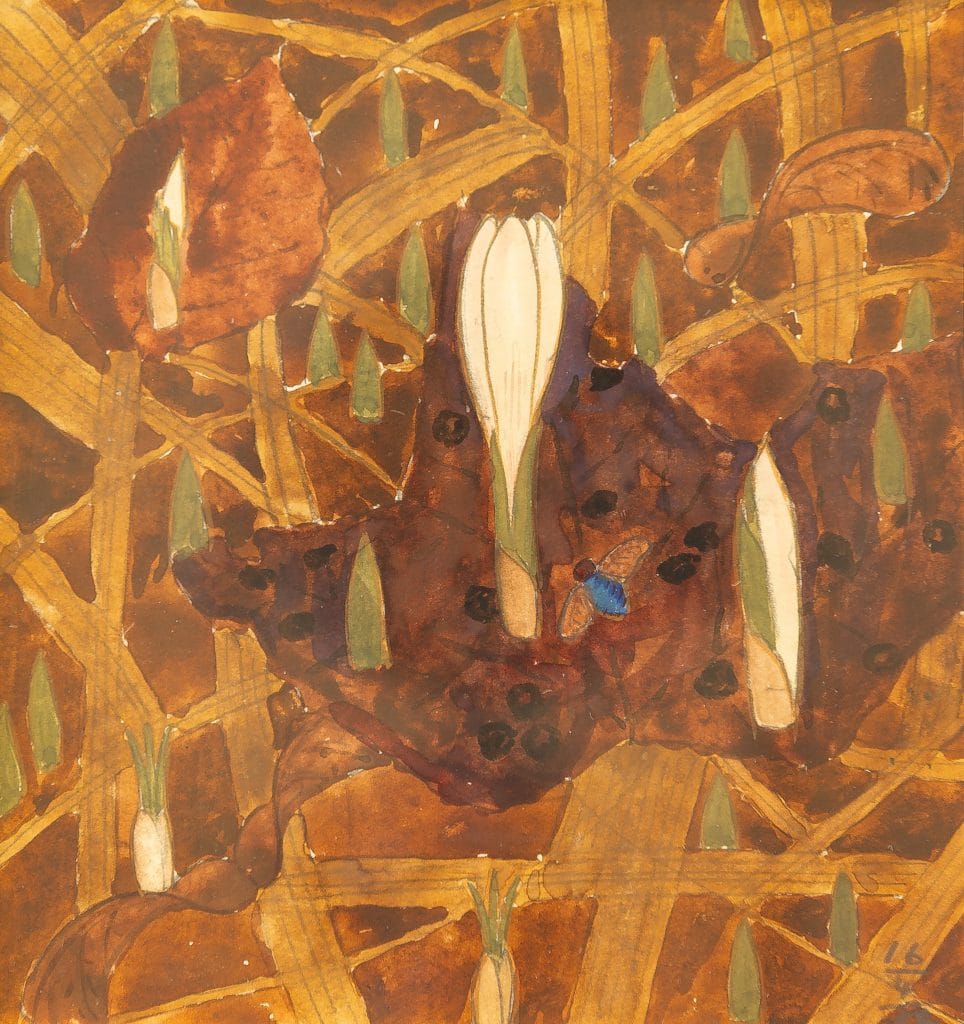
The work presents a dense, almost ornamental composition of plant structures that fills the entire pictorial space. The colour palette is dominated by warm, earthy browns, reminiscent of withered autumn leaves, damp soil and yellowed grass. This background structure appears like an interwoven network of leaves, stems and grasses, rendered in a wide range of shades of ochre, sienna and dark brown. Rising from this dense, organic ground are several narrow, elongated flower forms. They are set in lighter, almost whitish-cream tones and thus appear as delicate accents of light within an otherwise dark ensemble. Their slender, upward-pointing silhouettes create a vertical tension in the image. Alongside them, smaller greenish elements appear, generating additional movement and depth. Individual dabs of vivid blue or black create minimal yet effective contrasts that guide the viewer’s eye through the composition.
The painterly handling is typical of Evard’s early phase: the brushwork appears precise yet organic, and the forms interlock into a rhythmic structure that already points to his later turn towards abstraction. The work combines observation of nature with increasing stylisation, so that, despite its representational character, the motif develops an almost abstract, mosaic-like effect.