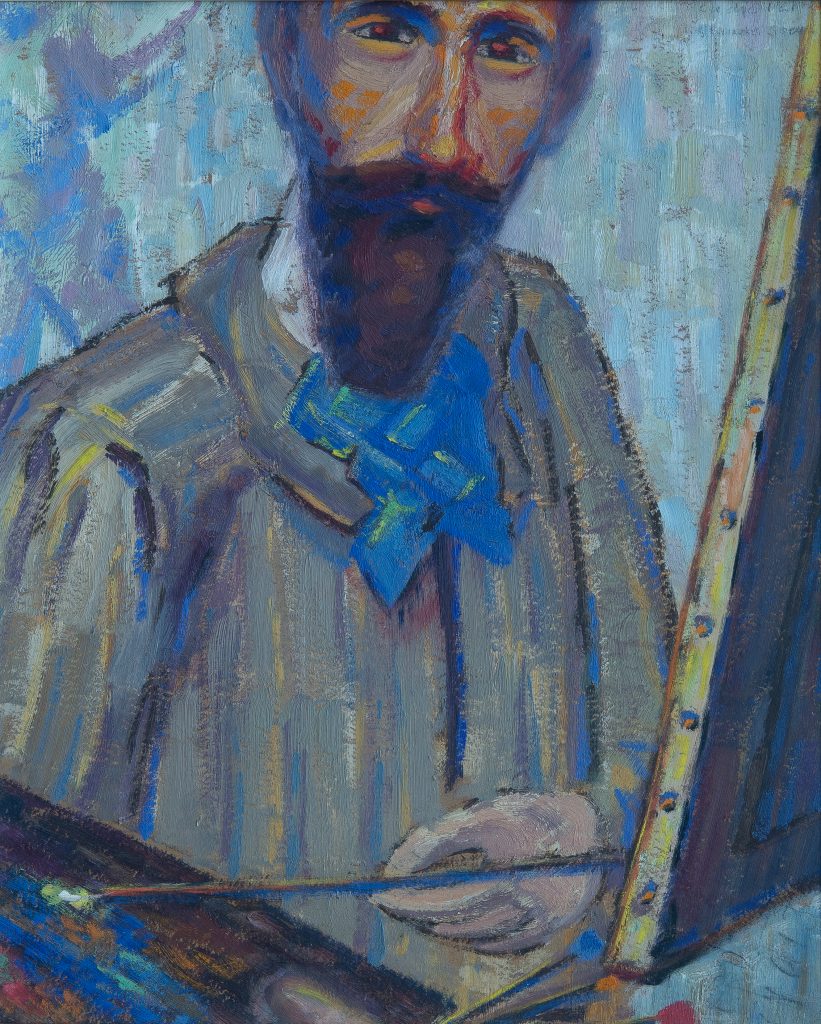
The painting shows Evard in the role of the artist, with palette and brush, concentrating on his work. With a steady gaze, he faces the viewer. In his beige painter’s jacket and blue neckerchief, he appears both serious and calm. The easel is depicted cropped, creating the impression that one is observing the artist in the midst of the creative process.
The color scheme is rich in contrast: warm ochre tones meet shades of blue and violet. The brushstrokes are clearly visible and give the surface a lively, structured effect. The background consists of vertical color stripes that create no depth, but rather place the painter in an almost abstract, spiritual space.
In terms of content, the work reflects Evard’s self-conception as an artist. He presents himself not merely as a craftsman, but as a reflective creator who contemplates his own role. The portrait marks a transitional phase in his work: still figurative, yet already modern in color application and composition, it points toward his later turn to geometric abstraction.